Midpoint Formula
The midpoint formula finds the point exactly halfway between two points (x₁, y₁) and (x₂, y₂): . In words: average the two x-coordinates, and average the two y-coordinates. For (2, 3) and (8, 7) the midpoint is (5, 5).
What is a midpoint?
The midpoint of a line segment is the point on the segment that divides it into two congruent halves — it is the same distance from both endpoints. Every segment has exactly one midpoint.
The formula works because the midpoint is the average position of the two endpoints. Averaging the x-coordinates puts it halfway across; averaging the y-coordinates puts it halfway up. A line that passes through the midpoint is said to bisect the segment, and a bisector that also meets it at 90° is the perpendicular bisector.
How to find the midpoint in 3 steps
Using the endpoints (2, 3) and (8, 7):
- Add the x-coordinates and halve: (2 + 8) / 2 = 10 / 2 = 5.
- Add the y-coordinates and halve: (3 + 7) / 2 = 10 / 2 = 5.
- Write them as a point: M = (5, 5).
Always add — never subtract. Subtracting is what the distance and slope formulas do, and it is the most common midpoint mistake.
Midpoint formula at a glance
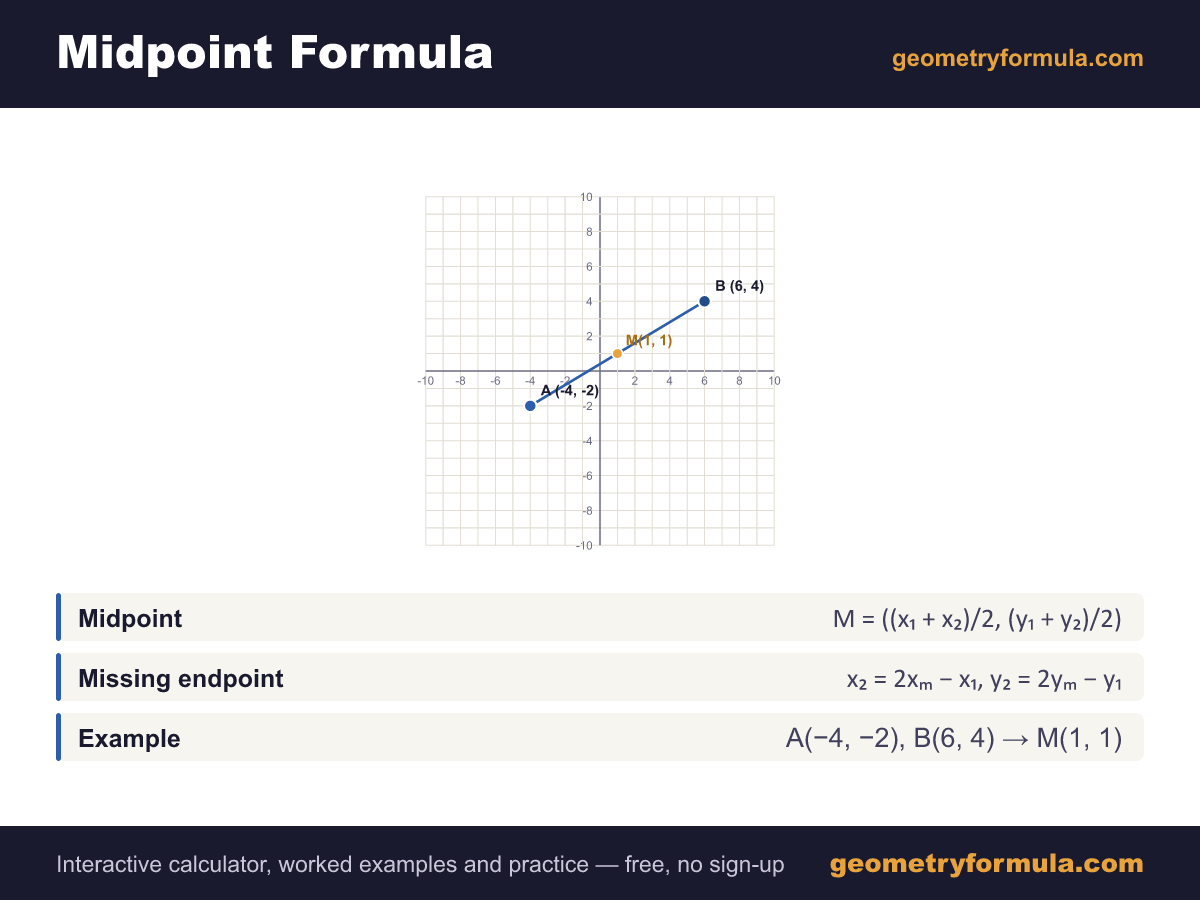
Midpoint calculator
Type two points, or drag A and B on the grid (click a point and use the arrow keys). The midpoint M is marked in amber and the full substitution updates as you go. Points snap to whole numbers from −10 to 10.
Drag a point, or click it and use the arrow keys. Coordinates snap to the grid.
Step-by-step substitution
- M = ((x₁+x₂)/2, (y₁+y₂)/2) = ((-4+6)/2, (-2+4)/2) = (1, 1)
Worked examples
- (2, 3) and (8, 7) (whole numbers): M = ((2 + 8) / 2, (3 + 7) / 2) = (5, 5).
- (0, 0) and (3, 4) (an odd sum gives a half): M = ((0 + 3) / 2, (0 + 4) / 2) = (1.5, 2).
- (−4, −2) and (6, 4) (negative coordinates): M = ((−4 + 6) / 2, (−2 + 4) / 2) = (1, 1).
- (−7, 1) and (−1, −6) (both negative, decimal answer): M = ((−7 + (−1)) / 2, (1 + (−6)) / 2) = (−4, −2.5).
How to find a missing endpoint
If you know one endpoint (x₁, y₁) and the midpoint (xₘ, yₘ), run the midpoint formula backwards. Since the midpoint is halfway, the other endpoint is the same step again beyond it:
- Endpoint (1, 4), midpoint (3, 6): (x₂, y₂) = (2·3 − 1, 2·6 − 4) = (5, 8). Check: the midpoint of (1, 4) and (5, 8) is (3, 6). ✓
- Endpoint (−2, 5), midpoint (1, −1): (x₂, y₂) = (2·1 − (−2), 2·(−1) − 5) = (4, −7). Check: the midpoint of (−2, 5) and (4, −7) is (1, −1). ✓
Always check by finding the midpoint of your answer and the known endpoint — it should give back the midpoint you started with.
Midpoint formula vs distance formula
They use the same two points and are often taught together, but they answer different questions. Shown here for (2, 3) and (8, 7):
| Midpoint formula | Distance formula | |
|---|---|---|
| Gives you | A point (x, y) | A length (a single number) |
| Formula | ||
| Operations | Add, then halve | Subtract, square, add, square root |
| Example | (5, 5) | √52 ≈ 7.21 |
See the distance formula for the full method.
Midpoint on a number line and in 3D
On a number line there is only one coordinate, so the midpoint of a and b is simply . Halfway between −3 and 7 is (−3 + 7) / 2 = 2.
In three dimensions the z-coordinates are averaged the same way:
The midpoint of (1, 2, 3) and (5, −4, 9) is (3, −1, 6).
Where the midpoint formula is used
Centre of a circle. The centre is the midpoint of any diameter. If a diameter runs from (−3, 2) to (5, 8), the centre is (1, 5) and the radius is half the diameter's length, 5.
Triangle midsegments. A segment joining the midpoints of two sides of a triangle is parallel to the third side and half its length. In the triangle with vertices (0, 0), (8, 0) and (2, 6), the midpoints of the two slanted sides are (1, 3) and (5, 3). The segment between them has length 4 — half of the base's 8 — and, like the base, it is horizontal.
Perpendicular bisectors. To construct the perpendicular bisector of a segment, find its midpoint first; the bisector passes through it at a right angle.
Common mistakes
- Subtracting instead of adding. ((8 − 2)/2, (7 − 3)/2) = (3, 2) is half of each horizontal and vertical gap, not a point on the segment. The midpoint of (2, 3) and (8, 7) is (5, 5).
- Averaging the midpoint with the known endpoint. With endpoint (1, 4) and midpoint (3, 6), averaging gives (2, 5) — a point a quarter of the way along. The missing endpoint is (5, 8).
- Dropping a negative sign. (−4 + 6)/2 = 1, not −5. Write the signs in before you add.
- Mixing up coordinates. Add x to x and y to y. Pairing x₁ with y₂ gives a point that has nothing to do with the segment.
Practice problems
- Midpoint of (0, 0) and (10, 6)
Answer
(5, 3)
- Midpoint of (1, 1) and (7, 9)
Answer
(4, 5)
- Midpoint of (−6, 2) and (2, −4)
Answer
(−2, −1)
- Midpoint of (3, 5) and (4, 8)
Answer
(3.5, 6.5)
- Midpoint of (−5, −5) and (5, 5)
Answer
(0, 0)
- One endpoint is (2, −1) and the midpoint is (4, 3). Find the other endpoint.
Answer
(6, 7)
- One endpoint is (−5, 0) and the midpoint is (−1, 2). Find the other endpoint.
Answer
(3, 4)
- Midpoint of (2, 0, −4) and (6, 8, 2) in 3D
Answer
(4, 4, −1)
Related
Classroom use: midpoint formula
Learning objectives
After using this page, students will be able to:
- Compute a midpoint by averaging the x- and y-coordinates.
- Find an endpoint given the midpoint and the other endpoint.
- Use midpoints to locate the centre of a circle or the diagonals of a parallelogram.
Suggested classroom activity
Emphasise that the midpoint is an average, not a difference — the confusion with the distance formula is the recurring error. Have students drag one endpoint and watch the midpoint move at half the rate; that halved motion is the formula made visible.
Standards alignment
| Code | Standard |
|---|---|
HSG.GPE.B.6 | Find the point on a directed line segment that partitions it in a given ratio. |
Free to use and adapt in class under the terms on our license page — no account, no sign-up, no ads. Content last reviewed August 2026.
Frequently asked questions
What is the midpoint formula?
The midpoint formula finds the point exactly halfway between (x₁, y₁) and (x₂, y₂): M = ((x₁ + x₂)/2, (y₁ + y₂)/2). It is the average of the two x-coordinates paired with the average of the two y-coordinates. For (2, 3) and (8, 7) the midpoint is (5, 5).
How do you find the midpoint of a line segment?
Add the two x-coordinates and divide by 2, then add the two y-coordinates and divide by 2. Those two results are the midpoint's coordinates. For endpoints (2, 3) and (8, 7): (2 + 8)/2 = 5 and (3 + 7)/2 = 5, so the midpoint is (5, 5).
How do you find a missing endpoint when you know the midpoint?
Double the midpoint and subtract the endpoint you know: x₂ = 2xₘ − x₁ and y₂ = 2yₘ − y₁. If one endpoint is (1, 4) and the midpoint is (3, 6), the other endpoint is (5, 8). Check it: the midpoint of (1, 4) and (5, 8) is (3, 6).
What is the difference between the midpoint formula and the distance formula?
The midpoint formula gives a point; the distance formula gives a length. Midpoint adds the coordinates and halves them. Distance subtracts them, squares, adds and takes a square root. For (2, 3) and (8, 7), the midpoint is (5, 5) and the distance is √52 ≈ 7.21.
Can a midpoint have decimal or fraction coordinates?
Yes. Whenever two coordinates add to an odd number, the midpoint coordinate is a half. The midpoint of (0, 0) and (3, 4) is (1.5, 2). Decimal and fractional midpoints are perfectly valid.
What is the midpoint formula in 3D?
Average each of the three coordinates: M = ((x₁ + x₂)/2, (y₁ + y₂)/2, (z₁ + z₂)/2). The midpoint of (1, 2, 3) and (5, −4, 9) is (3, −1, 6).